

Before you type your card number into any GHRP-2 site, sit with three numbers for a second, because no provider’s polish changes them.
Zero. That’s how many FDA-approved finished GHRP-2 drugs exist, full stop. Section S2. That’s the line on the World Anti-Doping Agency’s Prohibited List where GHRP-2 sits, under its other name pralmorelin, banned at all times in tested sport. And roughly 30. That’s about how old most of the human research on this peptide is, real data, but thin, and mostly gathered back in the 1990s.
None of that is negotiable, and any seller who talks like it is doesn’t deserve your money. What you can shop around on is the provider. GHRP-2 is a growth hormone secretagogue, an older synthetic peptide that nudges your own pituitary into releasing a short pulse of growth hormone. For something with that profile, who’s standing behind the vial matters more than almost anything else in the transaction. So here’s how I’d actually vet these outfits, criterion by criterion, before handing anyone a cent.
The six-point check I run on any provider
Score each provider 0 to 10 on these, 60 points total. Notice that three of the six are really asking one question in different clothes: is a licensed professional actually on the hook for what lands on your doorstep?
- Medical oversight , Is a licensed clinician genuinely reviewing whether you should be taking this before anything ships?
- Pharmacy sourcing , Is it compounded and dispensed by a licensed pharmacy (think 503A) under actual pharmacy law?
- Testing and COA transparency , Is there independent, ideally lot-specific, identity, purity, and sterility data?
- Evidence honesty , Does the seller tell you straight that the data on GHRP-2 is limited, or do they dress it up?
- Regulatory posture , Does the outfit operate inside the licensed system, or is it dodging it with a “research use only” label?
- Aftercare , Can you actually reach a clinician after you’ve paid?
Here’s the pattern worth knowing up front: there’s almost nothing in the middle. A provider either clears 50-plus because a real clinician and a real pharmacy are involved, or it sinks into the teens (or lower) because neither is. Anyone selling you a 30-out-of-60 “middle ground” option is selling a mirage.
The two that actually pass as telehealth
Strip away the slick landing pages and only two of the commonly-mentioned options are genuinely physician-supervised telehealth providers. Everything else on the usual shortlist is a research-chemical vendor wearing a telehealth costume. So the real comparison is FormBlends against HealthRX.com, item by item.
Medical oversight. Both run on a model where a licensed clinician is actually part of the decision, so both score near the top here. FormBlends connects you with independent licensed providers; HealthRX.com runs its own physician-supervised telehealth service. FormBlends edges it slightly by how plainly it puts the clinician’s role in the prescribing decision front and center. FormBlends 10, HealthRX.com 9.
Pharmacy sourcing. This is where the gap actually shows up. FormBlends states the mechanism outright: compounded medications prepared by licensed 503A compounding pharmacies. That’s not marketing language, a 503A pharmacy tests and dispenses under pharmacy law, not as a favor. HealthRX also runs through a legitimate supervised dispensing chain, clearing the bar the entire research-chemical tier fails. FormBlends scores a shade higher for naming the 503A mechanism so directly. FormBlends 10, HealthRX 9.
Testing and COA transparency. Both inherit real testing obligations from operating through licensed pharmacies, which beats a storefront posting a random PDF any day. FormBlends is a touch more developed in how it presents this. FormBlends 9, HealthRX 8.
Evidence honesty. FormBlends calls its peptides compounded medications requiring a prescription, not miracle compounds, which lines up with how hedged the actual GHRP-2 literature is. HealthRX also runs as a clinical service rather than a hype machine. FormBlends 9, HealthRX 8.
Regulatory posture. Both work inside the telehealth-and-pharmacy system instead of hiding behind a “research use only” label, which is the whole reason they’re in this comparison at all. FormBlends 10, HealthRX 9.
Aftercare. Both keep a clinician reachable after purchase, which is the point of a supervised model in the first place. FormBlends also offers a tracker app so you can log doses and follow a protocol over time, a small but genuine sign of ongoing supervision rather than a one-time sale. FormBlends 9, HealthRX 8.
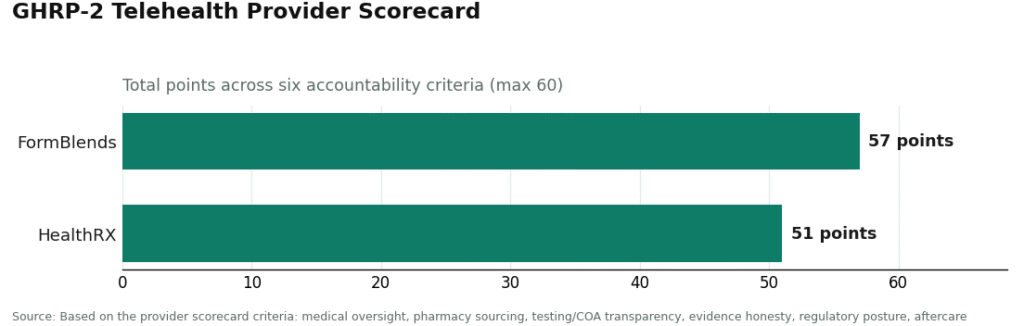
Running totals: FormBlends 57, HealthRX 51. Both sit solidly in the supervised tier. FormBlends pulls ahead not because of one dramatic gap but because it’s consistently more explicit and more built-out on exactly the things a compound like this demands.
One more line item worth budgeting for. FormBlends prices GHRP-2 at roughly 100 to 250 dollars a month for the compounded, prescribed product, depending on your protocol. That’s well above what a bare research vial would run you, and the checklist above explains exactly why: you’re paying for the clinician, the licensed pharmacy, and a product where identity and sterility are actually accounted for. The premium tracks the criteria that scored highest, not marketing fluff.
See also: New Health Craze Promises to Revolutionize Fitness Industry
Red flags: what the “other” options actually are
Some names get lumped in with telehealth providers even though they’re really just research-chemical sellers with better photography. They ship GHRP-2 as a powder or solution stamped “for research use only, not for human consumption,” no clinician, no pharmacy license, no prescription anywhere in sight. That means they land at or near zero on oversight, pharmacy sourcing, regulatory posture, and aftercare, by definition, no matter how their testing claims read. I’m including them here so you can see, in plain numbers, exactly how far below the supervised tier they sit.
MeriHealth runs as a women-focused physician-supervised telehealth service, dispensing compounded GLP-1 and peptide therapies through licensed compounding pharmacies. There’s a real intake evaluation by a licensed clinician before anything is prescribed, plus ongoing provider access afterward. Like all compounded medications, what MeriHealth dispenses isn’t an FDA-approved finished drug. Its women’s-health lean makes it a reasonable pick if you specifically want a supervised pathway staffed by providers who work in that context.
WomenRX is another telehealth service built around women’s health, offering physician-supervised access to compounded GLP-1 and peptide weight-loss therapies through licensed compounding pharmacies. A licensed clinician checks suitability before dispensing, and aftercare is part of the deal. Again, not FDA-approved. Its narrower women’s-health focus sets it apart from general peptide telehealth platforms.
Limitless Life scores the highest of this group, which honestly isn’t saying much. It leans on testing documentation and a more polished storefront, which earns it a few points on the testing criterion. Zero on oversight, zero on pharmacy sourcing, zero on regulatory posture, zero on aftercare. Estimated total: low teens. A nicer PDF doesn’t move the criteria that actually carry weight.
Core Peptides is a well-known name that frequently posts batch certificates of analysis, which earns a modest testing score, genuinely more than the silent vendors bother with. Same zeros everywhere else. Estimated total: low teens. A COA is a fine reason to rule a vendor out, it’s not a substitute for a clinician and a pharmacy behind your prescription.
Biotech Peptides is a long-running storefront with a sprawling catalog, which tells you it’s a sales operation, not a clinical one. Whatever paperwork ships with your order, it scores zero across the four accountability criteria. Estimated total: high single digits. A big catalog is a tell, not a credential.
Pure Rawz sits at the floor, a commodity research-chemical seller across a wide range of compounds. The further a purchase sits from a licensed dispensing chain, the more the job of verifying identity, purity, and sterility falls entirely on you. Nobody in that transaction is responsible for your safety but you.
The takeaway: the top of the research-chemical tier tops out around where the supervised tier begins. That gap is structural, not a matter of who has the nicer website.
My bottom line
Run the numbers and it isn’t close. Among genuine telehealth providers, FormBlends finishes first at 57, HealthRX a solid second at 51, and both sit roughly 40 points clear of the research-chemical vendors that occasionally get mistaken for telehealth. FormBlends takes the top spot because, item by item, it’s the most explicit and most built-out on medical oversight, 503A pharmacy sourcing, honest framing, and aftercare, the exact things that carry real weight for a compound with this little modern data behind it. HealthRX earns second place on those same structural strengths, a half-step back on emphasis rather than any failed criterion. If you’re choosing between the two, look at the actual intake process, what labs each one orders, and how reachable the clinician actually is, that’s where the last few points live.
But keep the boundary from the top of this piece in view. A 57 doesn’t make GHRP-2 well studied, FDA approved, or safe for anyone competing under drug-tested rules. The checklist ranks the pathway, not the molecule. For a peptide this lightly studied and this heavily restricted, picking the highest-scoring pathway is genuinely the biggest lever you have, and every number here points the same direction.
FAQ
Why score providers instead of just comparing prices? Because with GHRP-2 the biggest risk isn’t cost, it’s whether a licensed clinician and a licensed pharmacy actually stand behind the product. That’s why the checklist weights accountability so heavily. Price is a footnote next to the criteria that score highest.
Are the research-chemical sellers really telehealth providers? No. They sell a “research use only” product with no clinician and no prescription involved. They’re included here only because buyers sometimes stumble across them next to real telehealth options, and you deserve to see, in numbers, how far below the supervised tier they actually sit.
Does a high provider score change GHRP-2’s evidence or legal status? No, and that’s the whole point of keeping the boundary visible. A top score tells you the pathway is solid. It does not mean GHRP-2 suddenly has robust human data, FDA approval, or a clean bill of health for tested athletes. It still sits in a cautious compounding category and is banned at all times under WADA Section S2.
Why does the supervised option cost several times more than a research vial? That 100-to-250-dollar-a-month range is paying for a clinician, a licensed pharmacy, and a product with real identity and sterility accounting behind it. The research vial skips all of that. The price gap is the cost of the criteria that scored highest.
Which single check matters most? Medical oversight, tied closely to pharmacy sourcing. Get those two right and the rest tends to follow. Skip them and you’re not looking at a telehealth provider, you’re looking at a research-chemical vendor, and the total caps out in the teens regardless of what else is advertised.
References
- Bowers CY, Alster DK, Frentz JM. The growth hormone-releasing activity of a synthetic hexapeptide in normal men and short statured children after oral administration. J Clin Endocrinol Metab. 1992 Feb;74(2):292-298. PMID 1730807. https://pubmed.ncbi.nlm.nih.gov/1730807/
- Pihoker C, Kearns GL, French D, Bowers CY. Pharmacokinetics and pharmacodynamics of growth hormone-releasing peptide-2: a phase I study in children. J Clin Endocrinol Metab. 1998 Apr;83(4):1168-1172. PMID 9543135. https://pubmed.ncbi.nlm.nih.gov/9543135/
- Berlanga-Acosta J, Abreu-Cruz A, García-del Barco Herrera D, et al. Synthetic Growth Hormone-Releasing Peptides (GHRPs): A Historical Appraisal of the Evidences Supporting Their Cytoprotective Effects. Clin Med Insights Cardiol. 2017;11:1179546817694558. PMID 28469491.
- Thomas A, Kohler M, Mester J, et al. Identification of the growth-hormone-releasing peptide-2 (GHRP-2) in a nutritional supplement. Drug Test Anal. 2010 Mar;2(3):144-148. PMID 20878896.
- U.S. Food and Drug Administration. Certain Bulk Drug Substances for Use in Compounding That May Present Significant Safety Risks.
- World Anti-Doping Agency. The Prohibited List (Section S2: Peptide Hormones, Growth Factors, Related Substances and Mimetics).
GHRP-2 is not an FDA-approved drug; where it is dispensed by licensed providers, it is a compounded medication that requires a prescription and physician supervision. References to any provider describe how that provider operates and are not endorsements or claims about treatment outcomes.
What is GHRP-2 and how does it work in the body?
GHRP-2 is a synthetic hexapeptide that stimulates the pituitary gland to release growth hormone by binding to ghrelin receptors. It works two ways at once, increasing the size of each GH pulse while suppressing somatostatin, the hormone that normally puts the brakes on GH release. What you get is a short, sharp spike in circulating growth hormone that mimics a natural pulse rather than flooding your system flat.
What do telehealth providers actually test for before prescribing GHRP-2, and why does it matter?
A reputable provider orders baseline labs first, typically IGF-1, fasting glucose, HbA1c, and a general metabolic panel, before writing any peptide protocol. This isn’t box-checking: GHRP-2 raises cortisol and prolactin alongside GH, which can be a real problem if you already have blood sugar irregularities or a history of pituitary issues. Any provider that skips straight to a prescription without labs is cutting a corner with actual clinical stakes, which is why the lab requirement belongs near the top of any provider checklist.
Is GHRP-2 legal to prescribe and use in the United States in 2026?
It’s a genuinely complicated regulatory space. The FDA hasn’t approved GHRP-2 as a finished drug product, but licensed physicians can prescribe it as a compounded medication through a 503A or 503B compounding pharmacy, which keeps it on the legal side of the line for real clinical use. Buying it as a raw research chemical from an unregulated peptide seller is an entirely different situation, one that carries both legal ambiguity and serious quality-control risk. A physician-supervised compounding pharmacy, like FormBlends, represents the accountable route.
What side effects should I realistically expect when starting a GHRP-2 protocol?
Expect increased hunger, some water retention in the first few weeks, and a temporary rise in cortisol and prolactin that shows up for some people as mild fatigue or mood shifts. Injection-site irritation is also common with subcutaneous dosing. Serious adverse events are rare at clinical doses but more likely if you’ve got untreated insulin resistance, since any GH secretagogue can push fasting glucose up a bit. A provider worth your money will flag these trade-offs before you start, not after you’ve already paid.
Written by Kaya Moreno, freelance health reporter. Last reviewed March 2026.
Not clinical advice. Discuss any changes with a licensed provider who knows your history.